
Most eDiscovery platforms bill processing by the gigabyte. You hand over your data, they weigh it, and they charge you somewhere between $25 and $75 for every GB that goes in.
We think that is backwards, and I want to explain why, because the reason says a lot about how we price everything at Casefleet.
A gigabyte tells you almost nothing about cost
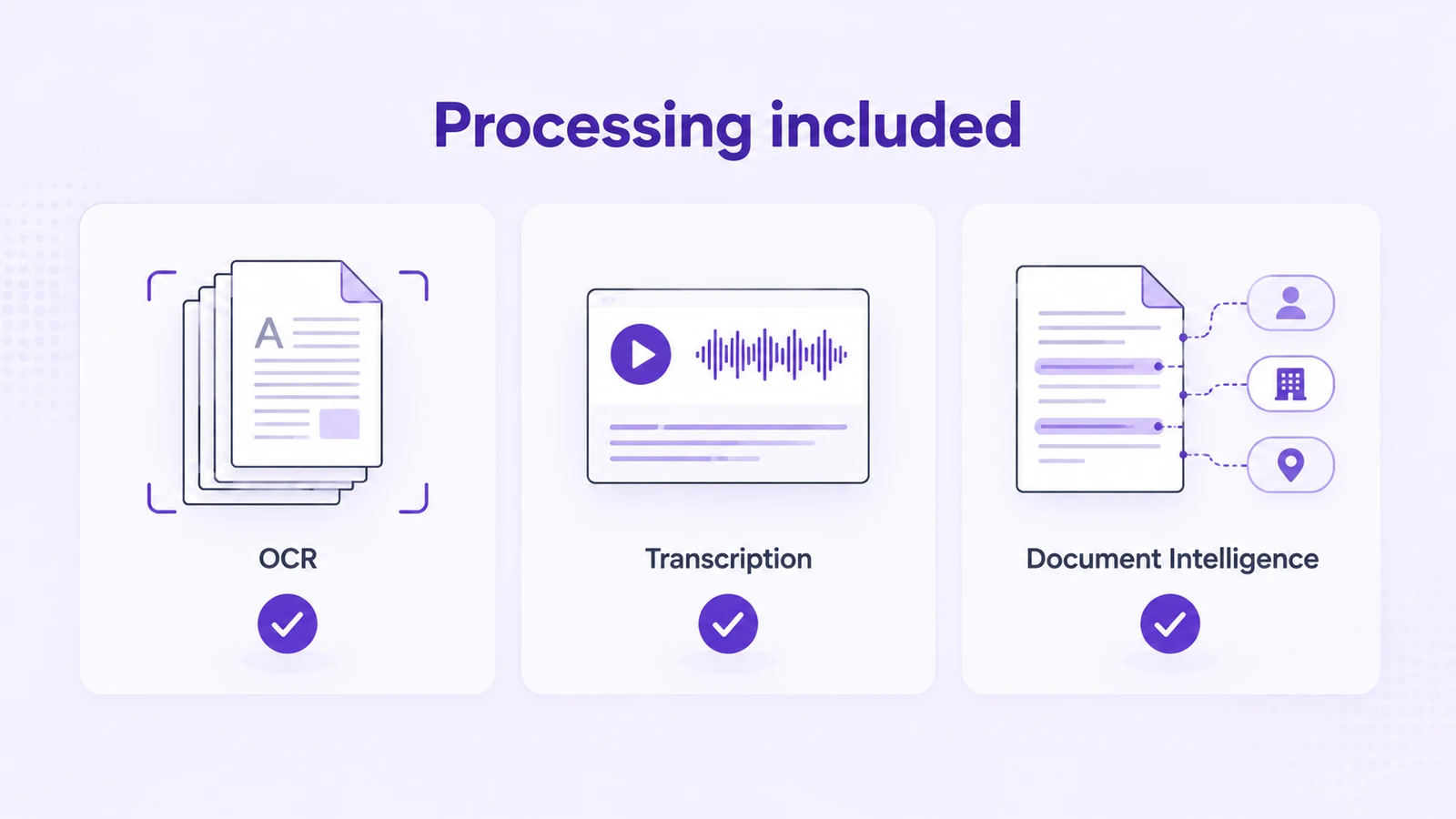
Here is the problem. The size of a file has very little to do with what it actually costs to process. The real work, and the real money, comes from two things: running OCR on pages that have no text, and transcribing minutes of audio and video. Neither of those tracks file size.
Consider three productions that are all the same size on disk:
- A folder of scanned documents. Small on disk, because scanned pages compress well, but it might hold hundreds of thousands of pages, every one of which needs OCR. Expensive to process.
- A set of deposition videos. Large on disk, but maybe only a few hours of footage. Modest to process.
- A pile of native spreadsheets and emails. They already contain text, so there is no OCR to run and nothing to transcribe. None of our metered charges apply.
Same gigabytes. Wildly different cost. A per-GB price tag would overcharge the first firm, overcharge the second, and overcharge the third, just by different amounts and in different directions. The number on the invoice would have almost no relationship to the work performed.
Video and audio make this even sharper. Transcription vendors charge by the minute of content, not by file size. A tiny, highly compressed voice memo can hold three hours of billable audio. The cheapest file to store can be the most expensive to transcribe. Charging for that by the gigabyte is not just imprecise, it is inverted.
We charge for the two things that actually drive cost
At Casefleet, processing has exactly two variable charges:
- OCR, billed per page that needs it. If a page already has a text layer, you pay nothing for it. You only pay for pages we actually have to read with OCR.
- Transcription, billed per minute of audio and video.
That is it. No per-gigabyte ingestion fee. No surcharge for the size of your data. You pay for the work that is genuinely metered and that genuinely costs us money on every job.
This is the honest version of the cost. When a page has no text and has to go through OCR, that is a real expense. When an hour of video has to be transcribed, that is a real expense. We pass those through, and we leave the rest alone.
“But how do I know the bill before I commit?”
This is the one fair advantage of per-gigabyte pricing: you know your gigabytes up front, so you get a number before you start. Page counts and audio minutes, on the other hand, are not obvious until the data is in.
So we solved that directly. Before you process, Casefleet analyzes your upload and shows you an estimate in the same units you will be billed in: how many pages, how many of those pages will need OCR, and how many minutes of media you have. For PDFs we look at whether each page already has text, so the estimate reflects the pages that will actually hit the OCR engine, not just a raw page count.
The quote, the invoice, and our underlying cost all speak the same language. With per-gigabyte pricing, the quote is in one unit and the real cost is in another, which is exactly why those vendors have to pad the rate to protect themselves.
What we choose to absorb
In the interest of being straight with you: a small amount of processing work does not fall neatly into pages or minutes. Pulling text out of native files, de-duplicating, building the search index, unpacking containers. That work scales more with file count than with pages.
We absorb it. Our pipeline is heavily optimized, the cost is small and predictable, and we would rather eat a minor, bounded expense than invent a fee for it and complicate your bill. We bill the two costs that are large, that scale, and that bite. We carry the rest.
The Casefleet difference
You should pay for the work done on your case, not for how much that work happens to weigh. We meter the two costs that actually scale, we show them to you before you commit, and we absorb the small remainder rather than dress it up as a line item.
That is the difference. It is a simpler story than the per-gigabyte incumbents can tell, and it is simpler because it is honest.
If you want to see what your next production would cost, upload it and Casefleet will show you the page and minute estimate before you process a thing.