


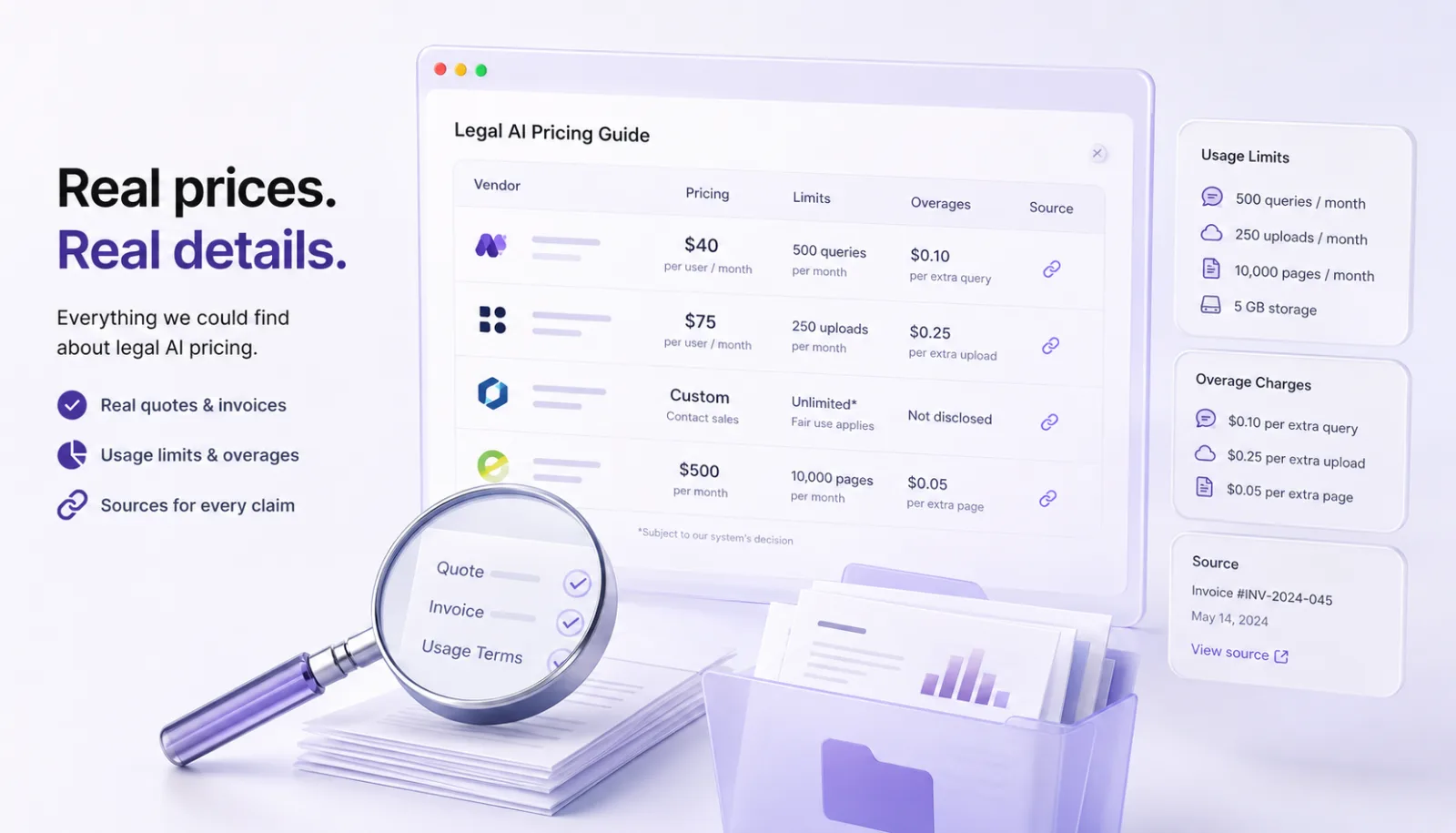
If you have tried to figure out what a legal AI tool actually costs, you already know the problem: for most of them, there is no price to find. No published rate. No pricing page with a number on it. Just a "Book a demo" button and a sales team that will give you a custom quote after they have sized up your firm. You cannot comparison shop, you cannot budget, and you cannot even tell whether you are being quoted the same deal as the firm down the street.
That is exactly why we built this page. We have pulled together everything we could find about what firms are actually paying for these tools, from vendor pages where they exist, from real quotes and invoices, and from practitioners who have reported their numbers. On top of the prices, we collected the usage limits and overage charges that almost never make it into the sales pitch: how many queries you get, how many documents you can upload, what happens when you go over, and whether "unlimited" means unlimited or comes with limits the vendor does not disclose.
It is a living document. We update it as vendors change their terms and as readers send us better information, and where we could not confirm something, we say so plainly instead of guessing. Most claims link straight to their source; where a figure rests on a third-party estimate rather than a named page, a footnote points to it.
October 1, 2026 update: We re-checked every vendor on this page. The big changes since June: Thomson Reuters now publishes self-serve Westlaw Advantage prices for firms with up to 10 attorneys, Briefpoint now publishes a flat per-attorney price, LexisNexis' per-use generative AI list prices are now covered, Legora moved its top-tier Agent Pro to consumption-based pricing, Smith.ai added a free tier, and several products were renamed (Westlaw Advantage, Lexis+ with Protégé, Manage AI, EveOS). The Casefleet section also reflects the September 29 removal of processing charges.
Got a correction, a screenshot of a quote, or a number we got wrong? Send it to company@casefleet.com. We would rather be accurate than tidy, and real invoices beat marketing copy every time.
Want the transparent option? Casefleet publishes its pricing, limits, and overage rates up front. Advanced AI is $140/user/month annually, with no seat minimum and a 14-day free trial.
The tools at a glance
Jump straight to any tool below. Prices marked "reported" or "estimated" come from third parties, not the vendor, because most of these companies publish no price at all. Read each section for the sourcing and the caveats.
| Tool | What it does | Typical price (per user/month unless noted) | Price published? |
|---|---|---|---|
| Harvey | Drafting, document analysis, research (enterprise) | ~$1,000–$1,200+ (reported) | No |
| CoCounsel | Litigation: review, depositions, research, drafting | ~$220–$500 (reported); small-firm bundles via TR's online configurator | Partly (firms up to 10 attorneys) |
| Westlaw Advantage | Research plus AI-assisted research and CoCounsel features | $256.75–$399.75 for firms up to 10 attorneys; ~$400–$700 all-in with CoCounsel (reported) | Yes, for firms up to 10 attorneys |
| Lexis+ with Protégé | Research, summarization, drafting | ~$128–$494 (reported); per-use AI list prices published | Partly (subscriptions custom quote) |
| Vincent (vLex / Clio) | Legal research, litigation analysis, drafting (Legal Pad) | ~$199/user/mo via standalone Clio Work (reported) | No |
| Legora | Enterprise drafting, bulk review, agentic research (Harvey rival) | ~$3,000/user/yr, 10-seat min (reported); Agent Pro billed by consumption | No |
| Spellbook | Contract drafting and review in Microsoft Word | ~$99–$350 (estimated) | No (custom quote) |
| Clio Manage AI (formerly Clio Duo) | AI assistant inside Clio practice management | Plans from $49; AI included or add-on depending on plan | Partly (starting price only) |
| Paxton AI | All-in-one assistant for solo and small firms | $499 ($2,999/year) | Yes |
| Briefpoint | Discovery drafting: interrogatories, RFPs, RFAs, responses | $150 per attorney/month, billed annually | Yes |
| Smith.ai | AI receptionist and client intake | Free (25 calls/month), paid plans from $150/month | Yes |
| EvenUp | Personal-injury demand packages and case valuation | Custom annual contract | No |
| Supio | Plaintiff & mass-tort AI: intake, medical chronologies, demands | No public price; ~$150–$300/user/mo (estimated) | No |
| Eve Legal (EveOS) | Plaintiff/PI: intake, demands, medical chronologies, discovery | ~$100–$300/user/mo (estimated) | No |
| Everlaw | Ediscovery and document review, with AI add-ons | Per-GB; ~$18–$35/GB/mo + AI credits (reported) | No |
| CaseMap+ AI | LexisNexis case analysis and management | Custom (est. ~$100–$200/user/mo) | No |
| Casefleet | Litigation workspace (facts, chronologies, documents) with AI | $30–$140 (annual) | Yes, including overage rates |
How to read this guide
A few ground rules, because accuracy is the whole point of this page:
- We separate what vendors publish from what other people report. A limit quoted from a vendor's own documentation is treated as solid. A price from a third-party roundup or a practitioner's first-hand account is labeled as such, because those go stale and vary by deal.
- Most premium tools do not publish a price, a usage limit, or an overage rate at all. That is not a gap in our research. It is the actual state of the market: you have to talk to sales to learn any of it, which is the single most important thing to understand before you start shopping.
- Pricing moves fast. Every figure here is point-in-time. Follow the link, or the footnote, before you rely on a number.
- "Unlimited" deserves scrutiny. Several tools market unlimited usage while running undisclosed throttling underneath, or reserve unlimited only for the top tier.
Last updated: October 1, 2026.
The thing nobody puts on a pricing page
Here is the pattern we found again and again. The tools that charge the most often publish the least, starting with the price itself.
For most enterprise legal AI, there is no pricing page to read. The best you can do is a seat price that leaked into a third-party roundup or a practitioner's review, and even that is just a starting point for a negotiation. What you essentially never find anywhere is the answer to the questions that actually determine your bill and your day-to-day experience: How many AI queries per month? How many documents can I push through at once? What is the cap on a single matter? And when I hit a wall, do I get throttled, cut off, or charged?
So you learn the price by sitting through a demo, and you learn the limits after you have signed, when you hit the wall in the middle of a real matter. We think that is backwards, and the rest of this page shows where each tool stands.
Before you sit through five demos, compare the questions that actually determine your bill: price, included usage, file limits, overage rates, and whether "unlimited" has throttles. Casefleet publishes all five.
Harvey
Public price: NoWhat it does: Document analysis, drafting, and research for large firms and corporate legal departments.
Price: Harvey does not publish pricing. Industry reports place it in the range of roughly $1,000 to $1,200 or more per user per month, with 12-month contracts and reported seat minimums of 20 to 25 seats. A third-party pricing tracker, Metronome's pricing index, characterizes Harvey as seat-based rather than metered, and lists figures in the range of $12,000 to $16,800 per seat per year for its current bundles, against a roughly $1,000 to $1,200 per seat figure it cites from early 2024. Treat those as third-party estimates, not Harvey's published rates, because Harvey publishes none.
Limits and overages: Because Harvey is sold as unlimited usage within a seat, there is no per-query meter and, by the same logic, no consumption overage. But "unlimited within a seat" is not the same as "no limits." Two things are worth knowing:
- Harvey's own API rate-limit documentation states hard per-minute throttles, applied per organization and reset every minute: 20 requests/minute on the Assistant completion endpoint, 10/minute on Vault endpoints, 60/minute on audit-log endpoints, 2/minute on history-export endpoints (Harvey's separate history-export guide still says 60), and 150/minute on client-matters endpoints. Exceed them and their backend rejects the requests that go over. The page frames this as ensuring "fair usage."
- Harvey's engineering team has written publicly about a "distributed, feature-aware rate limiting system" using a token-bucket algorithm that weighs each request by its prompt token count and scopes quotas per feature, user, and workspace. No numbers are disclosed. The takeaway is simple: server-side throttling exists, it is sophisticated, and you do not get to see its thresholds.
What we could not confirm: Harvey's actual per-seat contract price, any seat minimum, and the numeric thresholds of its internal throttling. All are negotiated and unpublished. Despite a reported surge in agent and token usage in 2026, Harvey has reportedly stuck with seat-based pricing rather than moving to metering. (See our Casefleet vs Harvey comparison.)
CoCounsel (Thomson Reuters)
Public price: NoWhat it does: Litigation-oriented AI: document review, deposition and transcript work, summaries, research, and drafting.
Price: Thomson Reuters now sells CoCounsel bundles online to firms with up to 10 attorneys, through a configurator on its Westlaw Advantage with CoCounsel Essentials pricing page; prices depend on jurisdictions, seats, and term length, and larger firms still get a sales quote. Third-party pricing aggregators list monthly tiers in the range of On demand at roughly $50 to $75 per task, Basic research around $220 per user per month, CoCounsel Core around $225, Westlaw Precision with CoCounsel around $428, and an All Access tier around $500 per user per month marketed as unlimited (see Costbench and this aggregator listing). A 2026 practitioner review by LawxyAI reports annual seat costs (Core around $4,500/year, climbing to roughly $10,200/year with Westlaw and Practical Law bundled) and notes CoCounsel "does not list a free trial for any of its plans" and is "designed around annual commitments." These are third-party figures; we could not find an official Thomson Reuters rate card to confirm them.
Limits and overages: This is where CoCounsel gets instructive.
- An attorney's first-hand account in Plaintiff Magazine from 2023, written about the Casetext-era version of CoCounsel before Thomson Reuters rebuilt it, describes a hard cap of 50 results per search, "regardless of how many hits the search turned up." When the author asked support how to raise it, they were told "this was how the system was designed and that the number of results could not be increased." That is a real, undisclosed limit that broke a real use case.
- Thomson Reuters' own help documentation for the Review documents skill states a per-run cap of 200 files at a time, with per-file size limits of 20MB for TXT, HTM, HTML, and RTF, and 500MB for PDF, DOC, DOCX, EML, MSG, and WPD.
- The next-generation CoCounsel Legal, which Thomson Reuters made generally available in August 2026, adds a tabular analysis feature that Thomson Reuters says handles up to 10,000 documents with up to 100 questions. That is a much higher ceiling than the Review documents skill, but it is a separate workflow.
We think the per-run cap of 200 files, combined with the per-file size limits, would be highly problematic for any case involving larger quantities of documents or very long documents, such as medical records. The new 10,000-document tabular analysis helps, but you still have to know which workflow carries which cap. Casefleet does not impose a per-run document cap: its AI works in the context of the entire case it relates to, however many documents that case holds.
What we could not confirm: Whether the "unlimited" All Access tier carries the same 50-result cap or any monthly query ceiling, and any per-tier overage charge. The vendor pages we found state none. (See our Casefleet vs CoCounsel comparison.)
Westlaw Advantage (Thomson Reuters)
Public price: Small firms onlyWhat it does: The research standard, now with AI-assisted research, Deep Research, and CoCounsel features. Westlaw Advantage replaced Westlaw Precision as the flagship tier and absorbs its AI features.
Price: This is a real change since our last update. Thomson Reuters' Westlaw Advantage plans page now publishes self-serve pricing for law firms with up to 10 attorneys: starting at $256.75 per month for single-circuit coverage and $399.75 per month for all states and federal, with 12% off for a 2-year term and 18% off for 3 years. Firms with more than 10 attorneys still have to contact sales, and a 7-day free trial is offered. For CoCounsel on top, a 2026 AI Vortex review reports CoCounsel access adds roughly $150 to $300 per user per month, and that a firm running Westlaw, CoCounsel, and Practical Law together can reach $400 to $700 per user per month. Those last figures are third-party, not vendor-published.
Limits and overages: Westlaw's underlying billing model is the original overage model, and it predates AI by decades. Thomson Reuters' current help page on out-of-plan charges still says that when you "retrieve or deliver documents that aren't included in your" subscription plan, you are charged the rates in the subscriber pricing guide. An older Thomson Reuters "Pricing guidelines for commercial plans" quick-reference guide, effective January 1, 2017, lays out the structure: your subscription covers searching and the content in your plan, but when you "retrieve or deliver documents that are not included in your subscription plan," you are billed per the rate card. Examples from that guide include a $99.00 cost-recovery charge per search, transactional document charges that run from $25.00 for a state or federal case up to $125.00 for a brief, and per-minute hourly browsing charges. Several public law-library guides describe the same out-of-plan overage model in plainer terms (Franklin County Law Library, Ave Maria School of Law): you get a warning that a document is outside your plan, and if you open it anyway, you pay extra.
We found no published monthly cap on Westlaw's Deep Research. Thomson Reuters describes it as deliberately slow, working for several minutes per query, which is a design choice rather than a quota.
What we could not confirm: Pricing for firms over 10 attorneys, any per-query AI cap, and whether the AI features carry their own out-of-plan charges. The transactional rate card above is the traditional research model and may not map cleanly onto the AI tiers.
Lexis+ with Protégé (LexisNexis)
Public price: PartialWhat it does: Research, summarization, drafting, and document analysis grounded in the LexisNexis content library. In February 2026, LexisNexis replaced Lexis+ AI with Lexis+ with Protégé.
Price: LexisNexis quotes custom pricing, typically bundled with a Lexis+ subscription. A third-party review lists an Essential tier around $128 per user per month and a Professional tier near $494[1]; we could not confirm these against an official Lexis price page. LexisNexis offers a 2-day free trial.
What LexisNexis does publish is per-use list pricing for generative AI, as part of its transactional price schedules for use outside a subscription plan. The Small Law price schedule lists Generative AI Ask at $60 and Generative AI Summarize and Drafting at $95 each, while the Large Legal price schedule lists Ask at $99 and Summarize and Drafting at $250 each. Those are list rates for out-of-plan use, not what a subscriber pays per query, but they are the closest thing to a published AI overage rate from any of the big research vendors.
Limits and overages: Lexis is unusually specific about some limits, and this is to their credit.
- LexisNexis' own Protégé product page states users are "limited to 25 Deep Research conversations per month." That cap applies to Protégé General AI's web-sourced Deep Research, not to research grounded in Lexis content.
- The upload help page states you can upload 10 files per session, 20MB maximum per file, with each document needing between 2,500 and 400,000 characters, in PDF, DOC, DOCX, or TXT.
- The Protégé Vault help page states you can create up to 50 Vaults, each holding up to 500 documents at 20MB per file. Uploads of 10 or fewer documents that are not saved to a Vault are purged at the end of the session.
We think the 10-file-per-session upload limit, the 400,000-character ceiling per document, and the cap of 25 Deep Research conversations per month would be constraining for document-heavy matters or very long records such as medical files.
What we could not confirm: Whether subscribers are ever charged the per-use AI rates above, the numeric "conversation limit" referenced (but not quantified) on the upload page, and the per-tier subscription pricing.
Vincent (vLex, now part of Clio)
Public price: NoWhat it does: vLex's AI legal assistant, now marketed as Vincent by Clio: cited legal research across vLex's database of case law, statutes, and regulations, 50-state surveys and jurisdiction comparisons, complaint and transcript analysis, contract review and redlines, litigation intelligence (judge, lawyer, and firm profiles), and a drafting feature called Legal Pad.
Price: vLex does not publish standalone Vincent pricing. Its Vincent page is sales-led, with a "Book a Demo" button and a free trial, and vLex states a subscription "will depend on the content you need to access, the number of licenses, length of subscription and additional products" (per its listed pricing statement). Third-party figures vary: vLex plans with Vincent included are reported to start around $69 per user per month[2], and Clio Work, Clio's AI workspace built on Vincent, became available as a standalone product in April 2026 at a reported $199 per user per month[3]. Clio's own help center says eligible US Clio Manage accounts are automatically enrolled in a 30-day Clio Work trial, and that users still holding licenses at the end of a 14-day opt-in trial "will be automatically converted to paid users," so watch the calendar. The Fastcase tier of vLex is free through 40+ state bar associations, but that free access excludes Vincent's advanced AI features.
Limits and overages: No monthly usage cap or overage is published, but Clio now publishes per-conversation limits. Its help article on analyzing documents in Clio Work lists files up to 1 GB each, up to 50 documents in a single conversation, and up to 500 documents processed at once in Vincent Tables.
What we could not confirm: Vincent's actual per-seat price and any monthly usage limit; Clio's pricing page for Clio Work is demo-gated.
Legora (formerly Leya)
Public price: NoWhat it does: A collaborative legal AI platform pitched as "the agentic operating system for legal work": bulk document review (Tabular Review), drafting from firm precedents in a Microsoft Word add-in, agentic legal research, regulatory monitors, and a client portal. It targets large international firms and in-house teams, and competes with Harvey.
Price: Legora does not publish pricing. Its site has no pricing page and routes you to a demo, with no public free trial. Multiple competitor writeups converge on list pricing of roughly $3,000 per user per year with a 10-seat minimum, which puts the floor near $30,000 per year[4], with enterprise deployments reported higher. Those figures come from companies selling Legora alternatives, so treat them as directional rather than confirmed.
Limits and overages: This changed in June. On June 23, 2026, Legora introduced consumption-based pricing for Agent Pro, its most capable agent: "you only pay for the work Agent Pro delivers, and the cost can be attributed to the project that drove it," with "real-time dashboards, notifications and spending controls." The standard Legora Agent stays on existing seat contracts at no additional cost. Legora has not published the price of a unit of consumption. Its August 2026 terms refer to separate credit terms covering credit purchases, consumption, and billing, which we could not find published. Legora's Acceptable use policy bars programmatic extraction of output and requires human review of AI output, but states no quotas. Onboarding, training, and DMS integration are reported as additional costs.
What we could not confirm: Any vendor-published price (every seat figure is a competitor-sourced estimate), the price of an Agent Pro credit, and any usage limit.
Spellbook
Public price: NoWhat it does: Contract drafting, review, and redlining inside Microsoft Word.
Price: Spellbook does not publish fixed pricing. Its own pricing page states pricing "is structured around the number of team members on your license" and routes you to a demo, with a 7-day free trial. Its terms of service make the service available "within the use limitations set forth in the Order," so whatever limits apply are set contract by contract, and no numeric limits are published. Third-party reviews from AI Vortex and Bind, both of which flag their numbers as estimates rather than published prices, describe a tier structure of roughly $99/user/month for a starter plan and around $149 for a professional plan. Enterprise estimates have climbed to roughly $199 to $350 per user per month, with reported 10-seat minimums and 6-month minimum commitments.
Limits and overages: This is the clearest example of "unlimited only at the top." Those same third-party reviews report the limits are expressed as AI-assisted drafts per month: roughly 150/month on the professional tier, a lower cap on the entry tier, and unlimited only on enterprise. We want to be precise: these draft counts come from third-party reviews that explicitly call them "point estimates, not published prices," not from Spellbook. Spellbook's own pages state no numeric caps or overages.
What we could not confirm: Any of Spellbook's actual prices, draft caps, or overage terms from a Spellbook source. All of it is custom-quoted behind a demo.
Clio Manage AI (formerly Clio Duo)
Public price: PartialWhat it does: An AI assistant built into Clio's practice-management platform: drafting, summarizing, and answering questions against your firm's own matter data.
Price: Clio Duo has evolved into Manage AI, sold per seat rather than metered. Clio's pricing page now publishes only a starting price, $49 per user per month, across its four plans, with the higher tiers behind "Get pricing" or a demo. Whether Manage AI is included or sold as an add-on depends on the plan, and the add-on price is quote-based.
Limits and overages: Across Clio's own pricing page, help center, and several third-party pricing breakdowns, we found no published per-user AI query limit, no AI-credit allotment, no overage charge, and no fair-use throttle for Manage AI. Access is by seat. The one hard, published limit we found at Clio is on the developer side: the Clio Platform API is capped at 3 requests per second per application, shared across all of an app's users, with no custom increases; exceed it and their backend rejects the requests that go over. That governs integrations, not the in-app AI assistant.
What we could not confirm: The Manage AI add-on price, and whether Manage AI has any internal usage ceiling. The absence of published limits is genuine, but absence of a published limit is not the same as proof there is none.
Paxton AI
Public price: YesWhat it does: An all-in-one assistant aimed at solo and small firms: drafting, research, document and contract analysis, and medical-chronology summaries.
Price: Here is a live example of why you should always check the source. Paxton's own pricing page, as of October 1, 2026, still lists an Individual plan at $499 per user per month, or $2,999 per user per year, with Enterprise at custom volume-based pricing. A 7-day free trial is offered, but it requires a credit card. Several 2025-era third-party roundups still cite Paxton in the $49 to $99 per user per month range. We could not reconcile that gap, and we are not going to paper over it: the current vendor page says $499/month. Either Paxton repriced significantly, or the older roundups are stale, or both. Verify it directly before you quote it.
Limits and overages: Paxton's pricing page states no query caps, document limits, or overage charges. Its Terms of Service reserve the right, "in our sole discretion and without limitation, notice, or liability, to remove from the Services or otherwise disable all files and content that are excessive in size or are in any way burdensome to our systems." That is a soft, discretionary fair-use clause rather than a published numeric limit. Paxton's help center does publish upload limits: up to 1 GB per file, and PDFs up to 2,500 pages.
What we could not confirm: Any numeric query or usage cap, and the reason for the price discrepancy above.
Briefpoint
Public price: YesWhat it does: Focused AI for discovery drafting: interrogatories, requests for production, requests for admission, and discovery responses. Its Autodoc feature turns a production into a ready-to-serve response document with Bates citations.
Price: Briefpoint now publishes its price. Its FAQ states that Briefpoint "has one flat-rate plan — the Rainmaker Plan at $150 per attorney per month, billed annually," including "flat-rate document generation with no per-case or per-document fees" and "all features included (no add-ons required)." Pricing scales with the number of attorneys. Older third-party figures ($89/month in one review[5], $210/month on a marketplace listing) are superseded by the vendor's own number.
Limits and overages: No per-case or per-document fees, and no overage schedule. Autodoc is recommended for "productions under roughly 10,000 pages," which is a best-fit guideline, not a billing cap.
What we could not confirm: Whether flat-rate generation carries any fair-use ceiling. (See our Casefleet vs Briefpoint comparison. Briefpoint is genuinely good at one thing, and is often complementary rather than competing.)
Smith.ai (intake and reception)
Public price: YesWhat it does: AI receptionist and client intake: answering calls, booking, and qualifying leads. We include it because intake is where small firms see the clearest return on an AI spend.
Price and overages: Smith.ai is one of the few here with a fully public, structured AI receptionist pricing page, including its overage logic, and it has repriced since our June update. There is now a free plan with 25 calls per month, with additional calls billed per call. Paid plans start at $150 per month for 75 calls, and the effective per-call rate falls as you commit to more volume (150 calls for $270, 300 calls for $500), with a 10% discount for a 12-month commitment. Larger volumes move to Enterprise and custom pricing. Smith.ai also lets you remove up to 10% of calls from each bill for spam. Going over your plan is metered per call, and the page tells you what that costs before you sign up.
EvenUp
Public price: NoWhat it does: AI-assisted demand packages and case valuation for plaintiff and personal-injury firms.
Price and overages: EvenUp does not publish prices. It describes its model as case-based pricing, "one clear, predictable cost per case," rather than per seat. Its published subscription terms fill in the mechanics: Credits are "prepaid, non-refundable units of value" redeemable at the quantities and rates in your order form, unused Credits terminate when the agreement does, and the terms allow for usage-based overages. So the terms worth reading closely before you sign are how credits are counted, what happens to unused credits, what the overage rate is, and what renewal looks like. In September 2026, EvenUp and LexisNexis announced an alliance to bring Protégé into EvenUp; no pricing was disclosed. If you have real EvenUp pricing details, send them our way. (See our Casefleet vs EvenUp comparison.)
Supio
Public price: NoWhat it does: An agentic AI platform built specifically for plaintiff and mass-tort firms: case intake, AI-generated medical chronologies, demand letters, case economics, and litigation document review.
Price: Supio does not publish pricing; it is enterprise and sales-led, and its site routes you to a demo. A third-party guide estimates roughly $150 to $300 per user per month across its tiers[6], and explicitly labels that an estimate rather than a vendor figure. Supio describes its pricing as a subscription based on case volume.
Limits and overages: Supio publishes no numbers, but it does make public no-limits claims. Its Why Supio page promises "predictable pricing with no surprises, page limits or edit penalties," and its blog says there are "no caps" and "no pay-per-page gimmicks." That is a meaningful commitment for medical-record-heavy plaintiff work. Get it in your contract.
What we could not confirm: Any Supio price. (See our Casefleet vs Supio comparison.)
Eve Legal (EveOS)
Public price: NoWhat it does: Butler Labs' AI platform built for plaintiff, personal-injury, and labor and employment firms: intake and case evaluation, medical chronologies, demand letters, and discovery drafting. In June 2026, Eve rebranded as EveOS, an "all-in-one AI operating system for plaintiff law" that adds AI agents, an auditor, an analyst, intake, and built-in legal research.
Price: Eve does not publish pricing. Its site offers only "Book a demo" and "Schedule a call." Multiple independent writeups confirm it: eesel states flatly that Eve "doesn't publish its prices anywhere online," and others estimate roughly $100 to $300 per user per month[7] on custom enterprise contracts. Every figure here is a third-party estimate, not vendor-confirmed.
Limits and overages: None disclosed. With no published price and no published terms, there is nothing to confirm.
What we could not confirm: Essentially everything quantitative. (See our Casefleet vs Eve Legal comparison.)
Everlaw
Public price: NoWhat it does: A cloud ediscovery and litigation review platform, with AI features layered in (a Review Assistant, a Writing Assistant, and batch AI actions).
Price: Everlaw's pricing page states that pricing "is based on the amount of data you manage and your usage," with "unlimited user licenses" and uploads "without limits on users or uploads," but it publishes no actual numbers and routes you to "Schedule a meeting." A third-party AI Vortex estimate puts hosting in the range of roughly $18 to $35 per gigabyte per month with volume discounts above about 500GB, and ITQlick models a first-year cost of $25,000 to $70,000-plus for a 10-user firm. These are third-party figures, not Everlaw's published rates.
Limits and overages: Everlaw is the clearest credit-and-overage model in this whole guide, and, to its credit, the structure is right on the pricing page. Single-document AI actions and the Writing Assistant are "included with your subscription at no extra cost." But batch AI actions "are charged based on usage" through separately purchased Credits, and "unused committed credit purchases will expire at the end of the term." Because the platform is priced per gigabyte of data, your bill scales directly with data volume, and third-party writeups note "overage fees for exceeding storage limits." Administrators can cap "total spend, and spend per matter," which is a genuinely useful control. Everlaw's November 2025 pricing changes added one more mechanism: Deep Dive, its case-wide question-answering feature, is billed as a one-time per-gigabyte ingestion fee with unlimited questions for the life of the case, while Review Assistant, Writing Assistant, and Deposition Analyzer are included in the per-gigabyte rate, which Everlaw said it was not raising.
What we could not confirm: The actual per-GB rate, the price of a Credit, and the base subscription fee. None are published. (See our Casefleet vs Everlaw comparison.)
CaseMap+ AI (LexisNexis)
Public price: NoWhat it does: LexisNexis' AI-driven case analysis and management tool, formerly CaseMap Cloud, now folding in the old TextMap and TimeMap.
Price: LexisNexis does not publish pricing. The product page routes you to sales ("contact LexisNexis directly... or calling 1-888-AT-LEXIS"), though a free trial is offered. Third-party estimates for CaseMap run around $100 to $200 per user per month[8], and a Vendr benchmark across all LexisNexis products shows a median negotiated contract of about $18,450 per year, across 94 purchases.
Limits and overages: No product-specific limits are published. The Vendr benchmark does flag two contract mechanics worth knowing, though they are company-wide rather than CaseMap-specific: "adding users mid-contract typically incurs pro-rated fees... LexisNexis may charge higher rates for unplanned additions," and "some contracts include annual true-up provisions that reconcile actual usage against contracted seats."
What we could not confirm: Any CaseMap-specific price or usage limit. (See our Casefleet vs CaseMap+ AI comparison.)
The patterns worth internalizing
Step back from the individual tools and a few patterns repeat:
- The premium tools publish the least. Harvey, Legora, Vincent, Spellbook, Supio, Eve, and EvenUp all require a sales conversation to learn the price, and none of them publish a clear overage schedule. Thomson Reuters has started publishing Westlaw Advantage and CoCounsel prices, but only for firms with up to 10 attorneys. The cheaper, self-serve tools tend to be more transparent.
- "Unlimited" is frequently conditional. It can mean unlimited only at the top tier (Spellbook), or unlimited within a seat while hard server-side throttling runs underneath (Harvey), or unlimited with an undisclosed per-search result cap (the CoCounsel account above).
- Consumption pricing is arriving at the top end. Legora now bills its most capable agent by usage, while Harvey has stayed with seats. As agents do longer, more expensive work, expect more vendors to meter it. Ask what a unit of consumption costs, and whether you can cap spend per matter, before you sign.
- The real overage vectors are predictable. Watch for per-seat minimums, mandatory annual commitments, usage caps that trigger extra charges, integration fees, and onboarding or training fees. None of those show up in a headline seat price.
- Accuracy is never guaranteed, so be wary of anyone who guarantees it. A peer-reviewed Stanford study found leading AI legal-research tools (Lexis+ AI, Westlaw AI-Assisted Research, and Ask Practical Law AI) hallucinated between roughly 17% and 33% of the time despite retrieval-augmented generation. Those were earlier versions of today's products, but no newer independent study has replaced it. That risk is inherent to AI legal tools generally, ours included; the red flag is not that a tool can make mistakes, it is the "hallucination-free" marketing that claims it cannot. Whatever you buy, keep a human in the loop and check the citations.
How Casefleet prices, and why we publish all of it
Public price: YesWe built Casefleet's pricing to be the opposite of everything above. The whole pricing page is public, there is no seat minimum, and you can start a 14-day free trial with just an email, no credit card and no sales call.
- Starter is $30 per user per month billed annually ($40 monthly): chronologies, fact and witness management, document review, outlines, and collaboration.
- Advanced AI is $140 per user per month billed annually ($180 monthly): everything in Starter plus document intelligence, AI-suggested facts drawn straight from your sources, named-entity recognition, natural-language search, agentic drafting for demand letters and motions, and unlimited documents.
- Enterprise is custom for larger teams (SSO, data migration, priority support).
OCR, media transcription, and Document Intelligence processing have no separate charge. Storage and AI credits retain their plan allowances and usage pricing. On Advanced AI:
- AI credits: 100,000 free credits per user per month, then $0.001 per credit.
- Storage: 5 GB included per account, then $10 per GB per month.
You can read every one of those numbers, and decide whether they work for your practice, before you ever hand us a dollar. No "contact sales to learn your limits." No discovering a 50-result cap in the middle of a matter. No quote that depends on your negotiating leverage.
That is the bet behind this entire page. When a market hides its prices and its limits, the firms that get hurt are the small and midsize ones without a procurement department. Publishing everything is how we would want to be treated, so it is how we price. See how we stack up against Harvey, CoCounsel, EvenUp, Supio, and Briefpoint, or just start a free trial and watch the meter yourself.
Help us keep this honest
Legal AI pricing changes constantly, vendors negotiate in private, and the published terms rarely tell the whole story. If you have a real quote, an invoice, a screenshot of a usage cap, or a correction to anything on this page, send it to company@casefleet.com. We will verify it, update the page, and keep the sources linked so everyone can see the receipts.
Footnotes
Most sources are linked inline above. These footnotes back the few figures that rest on a third-party estimate rather than a named vendor page. All re-checked as of October 1, 2026.
- Lexis+ tier prices ($128 and $494) are a third-party estimate, not LexisNexis-published. AI:Productivity — Lexis+ with Protégé pricing
- Vincent / vLex's "around $69 per user per month" figure is a third-party estimate for vLex plans with Vincent included, not a vendor-published price. AI Vortex — vLex / Vincent AI review
- The "$199/user/month" figure for standalone Clio Work is a press report, not a vendor rate card; Clio's own pricing page for Clio Work is demo-gated. LawNext — Clio Work available as a standalone product
- Legora's "~$3,000/user/year, 10-seat minimum" figures are reported by companies selling Legora alternatives, not published by Legora. LawxyAI — Legora pricing 2026
- Briefpoint's "$89/month" comes from a third-party review, not Briefpoint, and is superseded by Briefpoint's own published price of $150 per attorney per month. AI Vortex — Briefpoint review
- Supio's "$150 to $300 per user per month" is a third-party estimate; Supio does not publish pricing. ProPlaintiff — Supio pricing guide
- Eve Legal's "$100 to $300 per user per month" is a third-party estimate; Eve does not publish pricing. ProPlaintiff — Eve Legal pricing explained
- CaseMap's "$100 to $200 per user per month" is a third-party estimate; LexisNexis does not publish pricing. ITQlick — CaseMap pricing
Last updated: October 1, 2026. Every figure above is point-in-time; follow the link or footnote before relying on a number, and tell us when something has changed.